

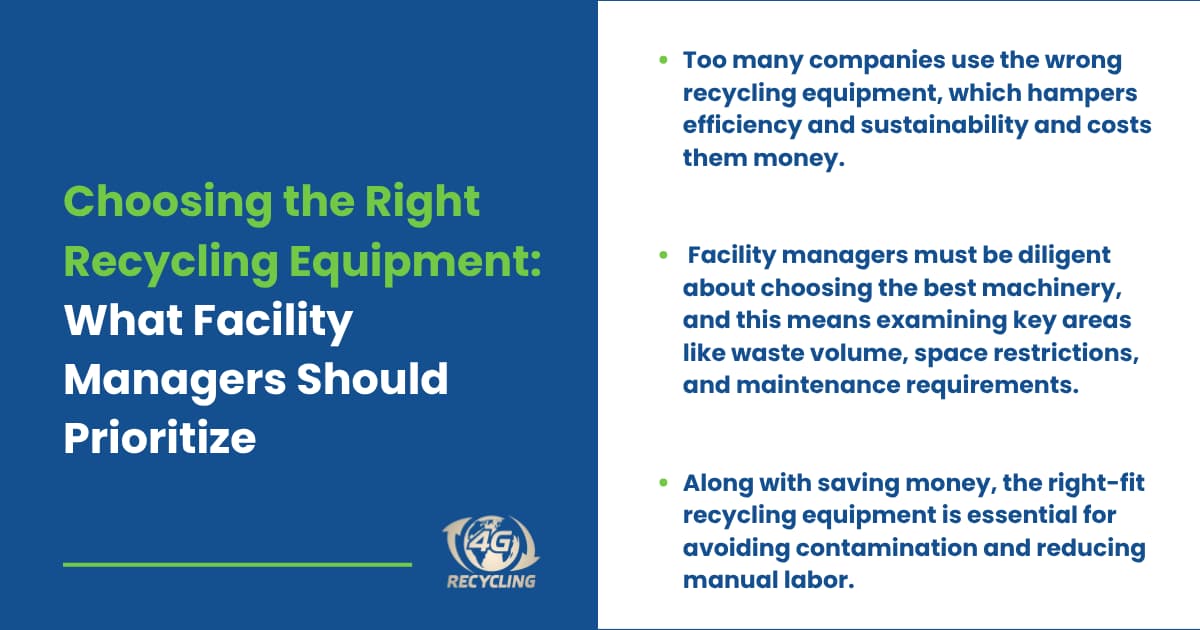
Choosing the Right Recycling Equipment: What Facility Managers Should Prioritize
Computers, printers, copiers, perhaps even a coffee machine. Whatever is needed to run your business, you have it. The right tools for the job help ensure maximized productivity and cost efficiency. It may be possible, however, that there are things you are overlooking that play a significant role in your company’s financial and environmental stance: your recycling equipment.
While organizations generally recognize the importance of recycling and doing their part for the planet, many aren’t using the right machinery. It’s extremely common for businesses to use equipment that’s too small, old, or outdated. It may also be overly complicated, which often leads to improper usage or not use at all. The wrong fit is another issue, as this can result in the need for more hauls, contamination, and missed rebates.
The bottom line is this: Recycling equipment is a long-term investment. What you choose needs to fit your space, waste stream, and operational flow. This guide is designed to help facility managers make the smartest choices.
What to focus on when selecting recycling equipment
When planning to make any big purchase, it’s easy just to concentrate on the price tag. And while that will undoubtedly be a factor when making decisions, it can’t be the only one. There are several other areas that you need to assess, including:
Waste volume throughput
Perhaps the most important thing to consider when choosing recycling equipment is the volume of waste and whether it can keep up with it. For example, smaller businesses that don’t have a lot of waste can typically utilize compact balers or shredders. Larger organizations might require compactors or more heavy-duty machinery like crushers or granulators.
The type of waste your company produces will also play a role. While items like cardboard and paper aren’t complicated to dispose of, things get more complex with metals and plastics. You may need a metal-specific baler with the former, and perhaps an extrusion machine with the latter.
Space restrictions
Some recycling equipment, such as a small baler, can fit almost anywhere. However, the other machinery mentioned above can be bigger and more intrusive. This is why you need to know how much space you have to work with. The equipment also has to have adequate room around it for operation and maintenance. In addition, it’s essential to think about the installation process’s logistics and power requirements.
Durability
Your recycling equipment may be fine now, but what about next year? Or five years down the road? Thinking about the future is essential when making business decisions. For instance, if you were dealing with a lot more waste at some point, could your equipment handle it? What if the type of waste changes?
Safety
Even basic recycling machinery can be dangerous if it isn’t appropriately operated. When considering equipment, you must consider your employees and their safety. Ensure everything is easy to use and has features like emergency stop buttons and automatic shut-off devices. For the well-being of both your workers and your company, it is also vital that anything you use complies with safety rules and regulations, along with OSHA requirements.
Maintenance
Another thing you can’t afford to overlook is maintenance. You should pick equipment that is easy to maintain and isn’t expensive to keep in good working order. Look up the manufacturer to find out about the support services they offer and the assistance they will provide if something goes wrong.
Sustainability
Last but certainly not least, you must know that your recycling equipment will help your company improve sustainability by reducing emissions and ensuring that more materials don’t end up in landfills. In addition, it has to meet all recycling regulations on the county, state, and federal levels. Compliance is crucial for avoiding fines and contributing to conservation.
The role of 4G Recycling
For over a century, 4G Recycling has been augmenting recycling processes for companies in various industries. We specialize in installing equipment for paper, plastic, and metal. We also provide logistics coordination, usage training, and servicing nationwide.
Why is right-fit equipment vital?
When you take all of the above criteria into consideration, you will find the right-fit recycling equipment. This will help your business:
- Save money: When your machinery is the perfect size, usage is optimized. For instance, the right baler maximizes bale density, which means fewer hauls and better rebates.
- Avoid contamination: Right-fit solutions help ensure that different materials are sorted properly, which improves recycling outcomes.
- Reduce manual labor: The ideal equipment enables fewer people to operate, which boosts efficiency and safety.
What type of recycling equipment do you need?
Choosing recycling equipment is a significant decision that shouldn’t be made lightly. 4G wants to make things much less complicated for you. We can audit your site and analyze your waste usage and material flow to offer recommendations. Examples of the types of machinery we have installed include:
- Vertical balers to handle daily cardboard flow for single-site warehouses
- Compactors to improve efficiency for retail chains
- High-capacity auto-tie balers, along with reporting systems for ESG tracking, for distribution centers
Ready for new recycling equipment?
If you’re still on the fence about whether or not you need to upgrade your recycling equipment, some red flags may push you over. For one thing, your hauling costs might keep going up. Perhaps you get frequent complaints from your staff about inefficient or unsafe machines. Maybe your business is expanding and your current solutions aren’t scalable.
4G wants you to get the most out of your recycling operations. Contact us for a facility walkthrough or an audit of your current equipment. We will ensure that your equipment drives savings and sustainability, without the headaches.
Recent Posts
5 Recycling Solutions That Deliver Measurable Sustainability Results
Waste recycling often costs more than it should due to frequent hauls, rejected materials, and multiple vendors, all of which add unnecessary expenses. Discover how the [...]
Envelope Recycling 101: What Businesses Need to Know About Disposal and Recovery
We may live in a digital age, with most of our communication sent via devices, but many of us, and companies in particular, still send and [...]
Flexible Recycling Solutions for Industrial Facilities: A Smarter, Scalable Approach for an Industrial Recycling Company
Not all industrial operations generate waste in the same way. Learn how adaptable recycling programs from an industrial recycling company can increase efficiency, compliance, and value [...]
Choosing the Right Recycling Equipment: What Facility Managers Should Prioritize
Computers, printers, copiers, perhaps even a coffee machine. Whatever is needed to run your business, you have it. The right tools for the job help ensure [...]
Turning Waste into Revenue: How the Right Paper Recycling Company Maximizes Value
Not all paper is created equal. Learn how smart sorting, cleaner fiber, and expert guidance from a paper recycling company like 4G Recycling can increase rebates [...]
What a Recycling Broker Actually Does (and How to Know If You Need One)
How much money does your business throw away every day? And we’re not talking figuratively; you may almost literally be tossing money in the trash. If [...]

