

Flexible Recycling Solutions for Industrial Facilities: A Smarter, Scalable Approach for an Industrial Recycling Company
Not all industrial operations generate waste in the same way. Learn how adaptable recycling programs from an industrial recycling company can increase efficiency, compliance, and value across multi-site facilities.
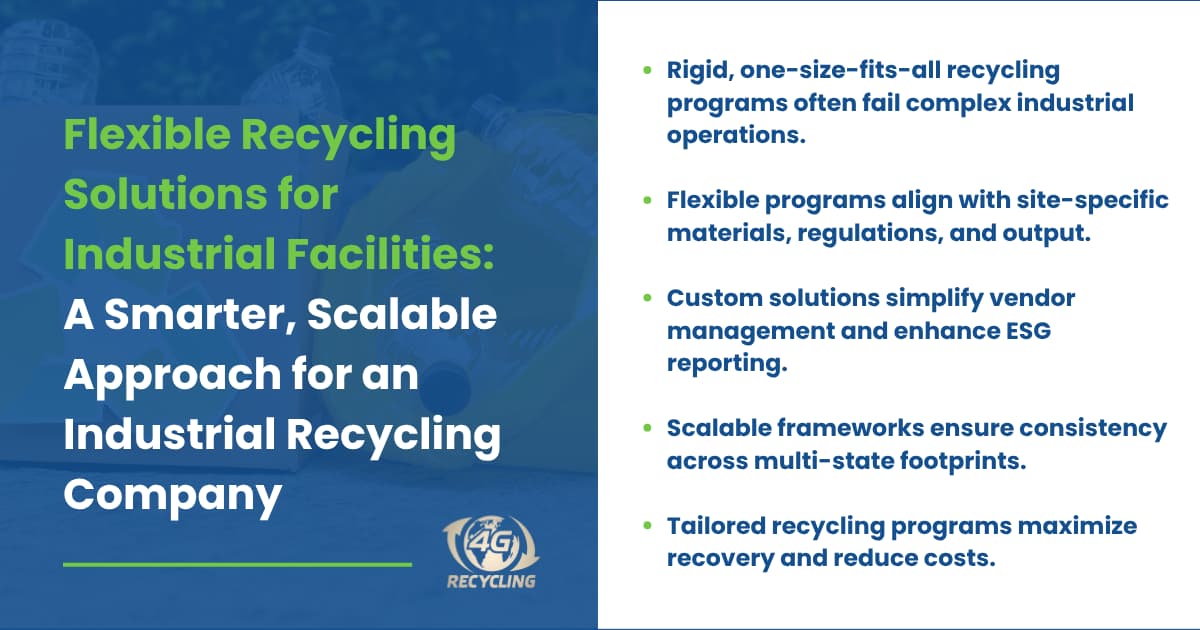
No two industrial sites look or operate the same. Your waste stream is unique, whether you’re managing a sprawling manufacturing campus, a network of logistics hubs, or distributed facilities across many states. And yet, many operators fall into the trap of applying a uniform recycling program across all sites, which results in lost value, inconsistent results, and vendor chaos.
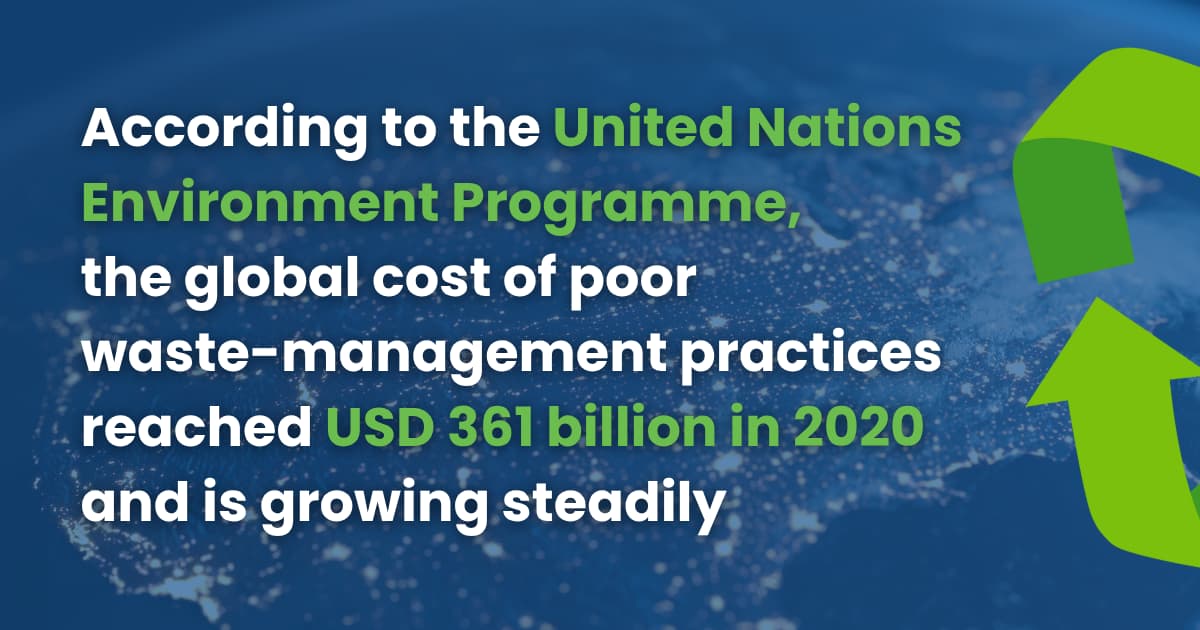
According to the United Nations Environment Programme, the global cost of poor waste-management practices reached USD 361 billion in 2020 and is growing steadily. If you work with an industrial recycling company, the real question is not “Are we recycling?” but “Are we recycling in a way that truly fits our operations and maximizes value?”
This article explores why flexible, custom-built recycling programs outperform rigid, one-size-fits-all approaches and how partnering with the right industrial recycling company can help your business improve efficiency, compliance, and long-term profitability.
The challenge of standard programs
The gaps are instantly evident when a recycling contract looks identical across multiple facilities. One plant might handle heavy metals and packaging scrap; another might process plastics, e-waste, or paper. Each operates under unique conditions, yet a uniform plan forces all to follow the exact pickup schedules, pricing, and equipment standards.
The result is missed revenue, inconsistent compliance, and the administrative burden of juggling multiple vendors. A recycling solution should adapt to your site, not vice versa.
Why flexibility matters in industrial recycling
Industrial waste varies by industry, region, and process. Manufacturing plants, logistics centers, and packaging warehouses all have different waste compositions and compliance requirements, and treating them equally leads to inefficiency.
While traditional recycling systems emphasize uniformity, 4G Recycling takes a tailored, scalable approach. We design custom recycling solutions built specifically for manufacturers, logistics hubs, and industrial campuses, recognizing that each site has its own materials, challenges, and operational rhythms.
Through national coverage and site-specific service plans, 4G Recycling ensures consistent performance across all locations without sacrificing local adaptability. Clients benefit from unified data reporting, responsive service teams, and reliable compliance tracking, all under one coordinated framework.
This approach simplifies vendor management, improves transparency, and ensures that every facility contributes to the organization’s sustainability goals.
What a tailored program delivers
Custom recycling programs deliver measurable results where standard ones fall short. A capable industrial recycling company helps organizations align recycling operations with real-world conditions. These programs are built on four key pillars:
- Material-specific recovery: Segregating OCC, plastics, metals, and e-waste for higher purity and more substantial rebates.
- Centralized reporting: Delivering unified ESG and audit data across all sites.
- Logistics and equipment alignment: Providing the proper containers, balers, and pickup schedules for each facility’s production flow.
- Simplified vendor coordination: Managing multiple facilities under one consistent service umbrella.
When these elements work together, recycling becomes a performance driver rather than a compliance task.
The business case for flexibility
Imagine a manufacturer with three production plants and two distribution centers. Each produces recyclable materials, but the mix differs: OCC and film at one site, aluminum and mixed plastics at another, and e-waste at the third. A rigid recycling plan applies the same pickup and pricing model, causing inefficiency.
By contrast, a flexible program adjusts service schedules and logistics based on each site’s waste profile. The result is cleaner materials, reduced hauls, and higher rebates. According to BusinessWaste, optimizing sorting and contamination control can increase material value by up to 30%, directly boosting both profit and sustainability performance.
The benefits compound for multi-state operations. A unified data system offers a complete view of recycling performance, allowing managers to compare sites, identify inefficiencies, and improve accountability across their network.
Assessing your current recycling performance
Before upgrading your system, evaluate where your recycling program stands. Many facility managers realize too late that their “efficient” system hides inefficiencies.
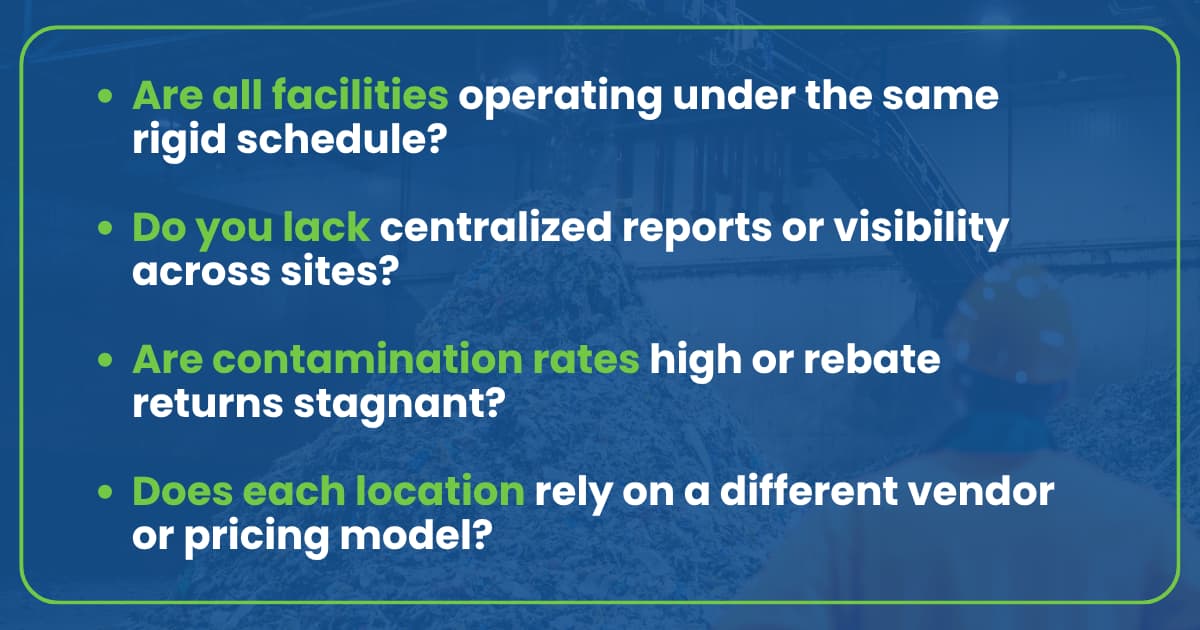
Start with these questions:
- Are all facilities operating under the same rigid schedule?
- Do you lack centralized reports or visibility across sites?
- Are contamination rates high or rebate returns stagnant?
- Does each location rely on a different vendor or pricing model?
If several answers raise concerns, it’s time to explore flexible recycling. This doesn’t mean scrapping your entire program, but restructuring it with the precision of an experienced industrial recycling company that knows how to align waste streams, logistics, and reporting under one adaptable system.
Moving from waste to value
Transitioning from static to flexible recycling transforms operations from reactive to strategic. Instead of managing waste as an afterthought, you build a circular model that generates measurable returns and supports sustainability commitments.
The best industrial recycling companies don’t simply collect materials; they empower organizations to capture value through data-driven insights, tailored logistics, and transparent reporting. The payoff includes:
- Increased material value and reduced haul frequency.
- Consistent compliance across state lines.
- Simplified communication under one scalable framework.
Time to reimagine your recycling strategy with 4G Recycling
The industrial world thrives on precision and adaptability. Your recycling program should do the same. Whether you manage a single site or a national footprint, flexibility is now the key differentiator between a cost center and a performance driver.
If your recycling program feels a little too rigid or out of sync with how your business really runs, it might be time for a change. Start by taking a good look at what’s working, and what’s not. Then team up with 4G Recycling. We build flexible, custom recycling programs that grow with your business and actually make a difference where it counts.
Contact us today to explore a tailored recycling strategy that grows with your operations while keeping control firmly in your hands.
Recent Posts
5 Recycling Solutions That Deliver Measurable Sustainability Results
Waste recycling often costs more than it should due to frequent hauls, rejected materials, and multiple vendors, all of which add unnecessary expenses. Discover how the [...]
Envelope Recycling 101: What Businesses Need to Know About Disposal and Recovery
We may live in a digital age, with most of our communication sent via devices, but many of us, and companies in particular, still send and [...]
Flexible Recycling Solutions for Industrial Facilities: A Smarter, Scalable Approach for an Industrial Recycling Company
Not all industrial operations generate waste in the same way. Learn how adaptable recycling programs from an industrial recycling company can increase efficiency, compliance, and value [...]
Choosing the Right Recycling Equipment: What Facility Managers Should Prioritize
Computers, printers, copiers, perhaps even a coffee machine. Whatever is needed to run your business, you have it. The right tools for the job help ensure [...]
Turning Waste into Revenue: How the Right Paper Recycling Company Maximizes Value
Not all paper is created equal. Learn how smart sorting, cleaner fiber, and expert guidance from a paper recycling company like 4G Recycling can increase rebates [...]
What a Recycling Broker Actually Does (and How to Know If You Need One)
How much money does your business throw away every day? And we’re not talking figuratively; you may almost literally be tossing money in the trash. If [...]

